Introdução
@p2play-js/p2p-game é uma biblioteca TypeScript modular para construir jogos multijogador P2P (WebRTC) baseados em navegador. Ela fornece sincronização de estado (completa/delta), estratégias de consistência (timestamp), um adaptador de sinalização WebSocket mínimo, auxiliares de movimento, eleição/migração de host, e uma sobreposição de ping.
Início rápido
npm install @p2play-js/p2p-game
import { P2PGameLibrary, WebSocketSignaling } from "@p2play-js/p2p-game";

const signaling = new WebSocketSignaling("jogadorA", "sala-42", "wss://seu-ws.exemplo");
const multiP2PGame = new P2PGameLibrary({
  signaling,
  maxPlayers: 4,
  conflictResolution: "timestamp",
});

await multiP2PGame.start();

multiP2PGame.on("playerMove", (id, pos) => {/* renderizar */});
Demos
-
Mini-jogo completo: examples/complete
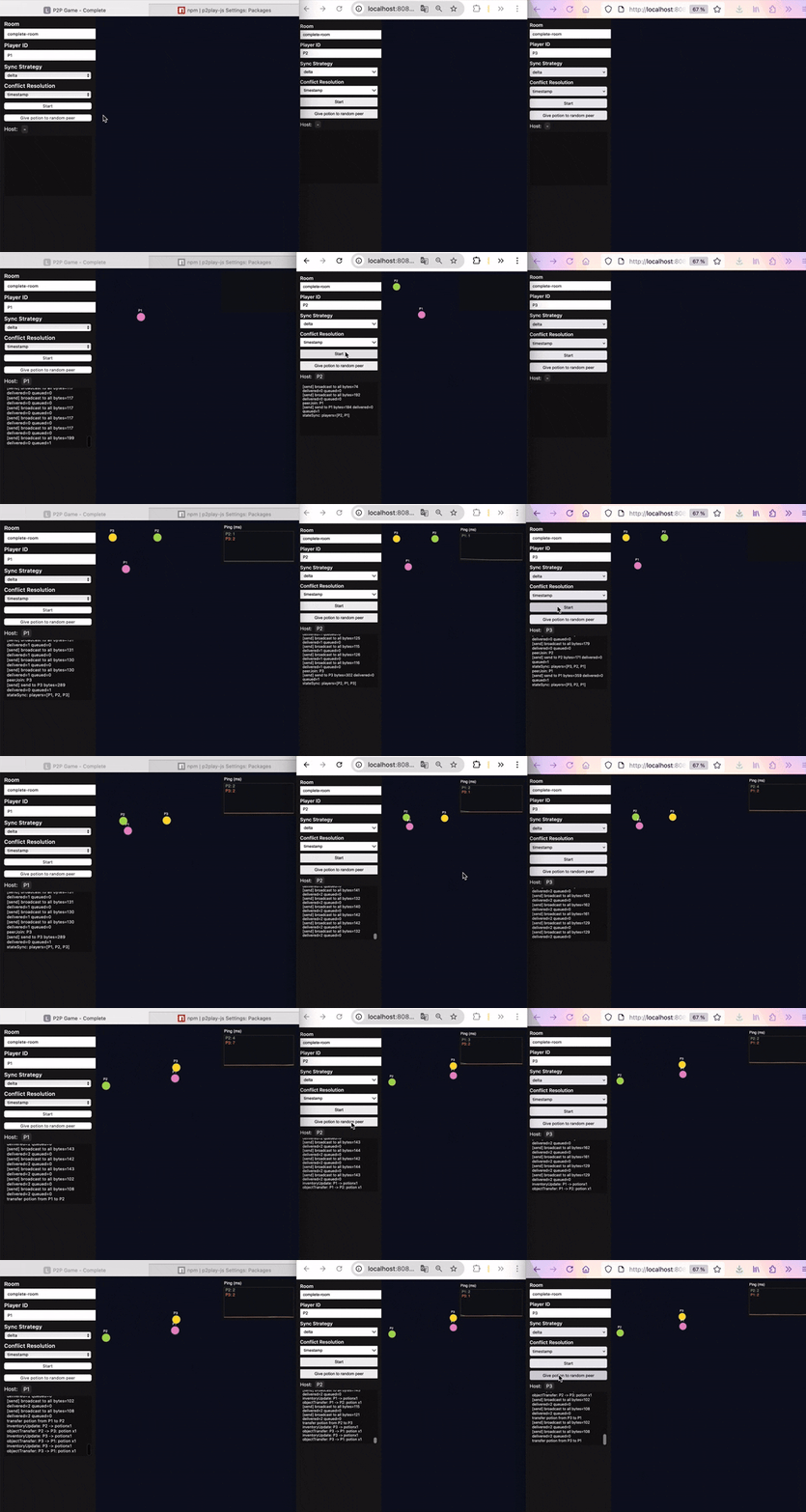
- Testador de sinalização básico: examples/basic
- Voz seletiva entre pares (talk / listen): examples/voice — Talk/Listen/Stop por par, mute global, reprodução de áudio remoto (ver Voz)
Arquitetura
- A biblioteca usa um servidor de sinalização WebSocket para gerenciar salas, manter uma lista de identificadores de jogadores, e rotear mensagens SDP/ICE para pares específicos.
- Os pares formam uma malha completa: para cada par de pares, aquele cujo
playerIdordena primeiro lexicograficamente cria a oferta WebRTC. Isso evita colisões de ofertas. - Uma vez estabelecidos os DataChannels, as mensagens de jogo fluem ponto-a-ponto; o servidor de sinalização não retransmite mais o tráfego da aplicação.
- A eleição de host é determinística: o menor
playerIdtorna-se o host. Quando o host sai, o próximo menor é eleito e envia um snapshot completo novo.
Sequência de sinalização
Topologia de malha completa
Sincronização de estado
- Snapshots completos: junções/migrações, ressincronização corretiva.
- Atualizações delta: mudanças de caminho direcionadas (abordagem híbrida na prática).
Consistência
- Timestamp (padrão): Last-Writer-Wins (LWW) por sequência por remetente.
seq seja menor que o último valor visto para aquele remetente é ignorada.Movimento
Esta biblioteca visa movimento suave mas previsível sob jitter de rede. Ela combina interpolação (suave entre amostras conhecidas) e extrapolação limitada (janelas de predição curtas) para esconder atualizações tardias sem divergir muito da verdade absoluta.
Interpolação
Quando uma nova posição remota é recebida, não mudamos instantaneamente para ela. Em vez disso, a cada frame movemos uma fração da distância restante.
O fator smoothing controla essa fração (0..1). Valores maiores reduzem o atraso visual mas podem parecer "flutuantes".
// Pseudocódigo
const clampedVx = clamp(velocity.x, -maxSpeed, maxSpeed);
const clampedVy = clamp(velocity.y, -maxSpeed, maxSpeed);
// allowedDtSec considera o limite de extrapolação (veja abaixo)
position.x += clampedVx * allowedDtSec * smoothing;
position.y += clampedVy * allowedDtSec * smoothing;
// eixo Z opcional se fornecido
0.2–0.3. Se o movimento atrasa as entradas, aumente; se oscila ou ultrapassa, diminua.
Extrapolação (com limite)
Se nenhuma atualização nova chegar neste frame, usamos temporariamente a última velocidade conhecida para projetar adiante. Para prevenir deriva, limitamos a janela de projeção com
extrapolationMs (por exemplo, 120–140 ms). Passado esse orçamento, paramos de projetar e aguardamos a próxima atualização de rede.
2D vs 3D
Posições e velocidades são 2D por padrão; adicione z para 3D simples. Se você definir worldBounds.depth, Z também será limitado.
Limites do mundo vs mundo aberto
Com worldBounds limitamos posições a [0..width] e [0..height] (e Z a [0..depth] se fornecido).
Para sandboxes de mundo aberto, defina ignoreWorldBounds: true para desabilitar todos os limites (colisões permanecem apenas jogador-vs-jogador).
Colisões (círculos/esferas)
As colisões usam círculos (2D) ou esferas (3D) de raio igual. Apenas o jogador local é reposicionado: as posições remotas são a fonte de verdade da rede e nunca são modificadas localmente. Quando o jogador local se sobrepõe a um jogador remoto, calculamos o vetor normalizado entre eles e empurramos o jogador local para longe pela distância total de sobreposição. Isso mantém o estado remoto com autoridade, evitando que o jogador local penetre nos outros.
// Jogador local L vs jogador remoto R, ambos com raio r
            const dx = R.x - L.x, dy = R.y - L.y, dz = (R.z||0) - (L.z||0);
            const dist = Math.max(1e-6, Math.hypot(dx, dy, dz));
            const overlap = Math.max(0, 2*r - dist);
            const nx = dx / dist, ny = dy / dist, nz = dz / dist;
            // Apenas L é movido, para longe de R, pela sobreposição total:
            L.x -= nx * overlap; L.y -= ny * overlap; L.z = (L.z||0) - nz * overlap;
O(n²)). Isso é adequado para salas pequenas. Para cenas lotadas, particionamento espacial (grades/quadtrees) pode ser adicionado ao nível da aplicação.
Fluxo: etapa de movimento
Resolução de colisão (círculo/esfera)
extrapolationMs) para evitar erro visível.
Detalhes de rede
- Estratégias de contrapressão: coalescência/abandonos para canais saturados.
- Capacidade: aplicação de
maxPlayers+ eventomaxCapacityReached. - STUN/TURN: forneça TURN para redes restritivas; use WSS para sinalização.
Contrapressão
Contrapressão protege o DataChannel de sobrecarga. Quando o buffer de envio interno do canal (exposto como RTCDataChannel.bufferedAmount) cresce além de um limite,
você pode momentaneamente parar de enviar, abandonar mensagens de baixo valor, ou colapsar múltiplas atualizações na mais recente.
send() aumenta bufferedAmount até que o navegador despeje dados pela rede.
Se você continuar enviando mais rápido do que a rede pode entregar, a latência explode e a aplicação gagueja. As estratégias abaixo mitigam isso.
Estratégias
- off: nenhuma proteção. Use apenas para mensagens pequenas e infrequentes.
- drop-moves: quando acima do limite, ignore novas mensagens de
movimento(entradas são transitórias; abandonar é frequentemente aceitável). - coalesce-moves: mantenha apenas o último
movimentopor par na fila, substituindo os mais antigos.
const multiP2PGame = new P2PGameLibrary({
    signaling,
    backpressure: { strategy: 'coalesce-moves', thresholdBytes: 256 * 1024 }
  });
Events & API (selection)
on('playerMove'),on('inventoryUpdate'),on('objectTransfer')on('stateSync'),on('stateDelta'),on('hostChange'),on('ping')broadcastMove(),updateInventory(),transferItem()broadcastPayload(),sendPayload()setStateAndBroadcast(),announcePresence(),getHostId()
Events overview
| Event | Signature | Description |
|---|---|---|
| playerMove | (playerId, position) | Movement applied |
| inventoryUpdate | (playerId, items) | Inventory updated |
| objectTransfer | (from, to, item) | Object transferred |
| sharedPayload | (from, payload, channel?) | Generic payload received |
| stateSync | (state) | Full snapshot received |
| stateDelta | (delta) | State delta received |
| peerJoin | (playerId) | Peer connected |
| peerLeave | (playerId) | Peer disconnected |
| hostChange | (hostId) | New host |
| ping | (playerId, ms) | RTT to peer |
| maxCapacityReached | (maxPlayers) | Capacity reached; new connections refused |
Lifecycle & presence
- Presence: call
announcePresence(playerId)early to emit an initial move so peers render the player immediately. - peerJoin/peerLeave: the UI can show/hide entities. Host‑side cleanup can be automated by enabling
cleanupOnPeerLeave: trueinP2PGameLibraryoptions: the host removes the leaving player's entries and broadcasts a delta accordingly. - Capacity limit: set
maxPlayersto cap the room size. When capacity is reached, the library will not initiate new connections and will ignore incoming offers; it emitsmaxCapacityReached(maxPlayers)so you can inform the user/UI.
Types Reference
GameLibOptions
type SerializationStrategy = "json" | "binary-min";
type ConflictResolution = "timestamp";

interface BackpressureOptions {
  strategy?: "off" | "drop-moves" | "coalesce-moves";
  thresholdBytes?: number; // default ~256KB
}

interface DebugOptions {
  enabled?: boolean;
  onSend?: (info: {
    type: "broadcast" | "send";
    to: string | "all";
    payloadBytes: number;
    delivered: number;
    queued: number;
    channel: "reliable" | "unreliable";
    serialization: SerializationStrategy;
    timestamp: number;
  }) => void;
}

interface MovementOptions {
  maxSpeed?: number;
  smoothing?: number; // 0..1
  extrapolationMs?: number;
  worldBounds?: { width: number; height: number; depth?: number };
  ignoreWorldBounds?: boolean;
  playerRadius?: number;
}

interface GameLibOptions {
  maxPlayers?: number;
  conflictResolution?: ConflictResolution;
  serialization?: SerializationStrategy;
  iceServers?: RTCIceServer[];
  cleanupOnPeerLeave?: boolean;
  debug?: DebugOptions;
  backpressure?: BackpressureOptions;
  timing?: { pendingOfferTimeoutMs?: number; pingIntervalMs?: number };
  pingOverlay?: { enabled?: boolean; position?: "top-left"|"top-right"|"bottom-left"|"bottom-right"; canvas?: HTMLCanvasElement | null };
  movement?: MovementOptions;
}
Events
type EventMap = {
  playerMove: (playerId: string, position: { x:number; y:number; z?:number }) => void;
  inventoryUpdate: (playerId: string, items: Array<{ id:string; type:string; quantity:number }>) => void;
  objectTransfer: (fromId: string, toId: string, item: { id:string; type:string; quantity:number }) => void;
  stateSync: (state: GlobalGameState) => void;
  stateDelta: (delta: StateDelta) => void;
  peerJoin: (playerId: string) => void;
  peerLeave: (playerId: string) => void;
  hostChange: (hostId: string) => void;
  ping: (playerId: string, ms: number) => void;
  sharedPayload: (from: string, payload: unknown, channel?: string) => void;
  maxCapacityReached: (maxPlayers: number) => void;
};

interface GlobalGameState {
  players: Record<string, { id:string; position:{x:number;y:number;z?:number}; velocity?:{x:number;y:number;z?:number} }>;
  inventories: Record<string, Array<{ id:string; type:string; quantity:number }>>;
  objects: Record<string, { id:string; kind:string; data:Record<string,unknown> }>;
  tick: number;
}

interface StateDelta { tick:number; changes: Array<{ path:string; value:unknown }> }
Tipos de voz (desde v0.3.0)
type VoiceMode = "talk" | "listen";
type VoiceState = "connecting" | "connected" | "disconnected" | "failed";

interface VoiceOptions {
  mode: VoiceMode;
  /** talk apenas — stream de saída personalizado; ignorado para listen. Padrão: getUserMedia({ audio: true }). */
  localStream?: MediaStream;
}

type VoiceEventMap = {
  remoteStream: (peerId: string, stream: MediaStream) => void;
  remoteStreamRemoved: (peerId: string) => void;
  state: (peerId: string, state: VoiceState) => void;
  error: (peerId: string, error: Error) => void;
};
Regras de caminhos delta
- Caminhos são chaves de objeto separadas por pontos (sem suporte para índices de array).
- Mantenha estruturas rasas e com chaves para atualizações direcionadas (ex.
objects.chest.42), evite arrays profundos.
// Bom: mapa de objetos
{ path: 'objects.chest.42', value: { id:'chest.42', kind:'chest', data:{ opened:true } } }

// Não suportado: caminho de índice de array como 'objects[3]' ou 'players.list.0'
P2PGameLibrary
Constructor
new P2PGameLibrary(options: GameLibOptions & { signaling: WebSocketSignaling | SignalingAdapter })
Lifecycle
await start(): Promise<void>
stop(): void
on<N extends keyof EventMap>(name: N, handler: EventMap[N]): () => void
getState(): GlobalGameState
getHostId(): string | undefined
setPingOverlayEnabled(enabled: boolean): void
tick(now?: number): void // apply interpolation/collisions once
State utilities
setStateAndBroadcast(selfId: string, changes: Array<{ path:string; value:unknown }>): string[]
broadcastFullState(selfId: string): void
broadcastDelta(selfId: string, paths: string[]): void
Gameplay APIs
announcePresence(selfId: string, position = { x:0, y:0 }): void
broadcastMove(selfId: string, position: {x:number;y:number;z?:number}, velocity?: {x:number;y:number;z?:number}): void
updateInventory(selfId: string, items: Array<{ id:string; type:string; quantity:number }>): void
transferItem(selfId: string, to: string, item: { id:string; type:string; quantity:number }): void
Payload APIs
broadcastPayload(selfId: string, payload: unknown, channel?: string): void
sendPayload(selfId: string, to: string, payload: unknown, channel?: string): void
API de voz (desde v0.3.0)
readonly voice: VoiceManager // ver a seção Voz
voice.start(remotePeerId: string, options: VoiceOptions): Promise<void>
voice.stop(remotePeerId: string): void
voice.stopAll(): void
voice.setMuted(muted: boolean): void
voice.isMuted(): boolean
voice.getActiveLinks(): Array<{ peerId: string; mode: VoiceMode; state: VoiceState }>
voice.on(event, handler): () => void // remoteStream | remoteStreamRemoved | state | error
Voz seletiva entre pares (talk / listen)
Desde v0.3.0, a biblioteca suporta áudio ponto-a-ponto seletivo sobre as
mesmas RTCPeerConnections já abertas para os DataChannels,
usando renegociação SDP padrão. Sem segunda conexão por par, sem servidor de mídia (SFU),
e zero mudanças no protocolo de sinalização: as ofertas/respostas de
renegociação reutilizam os envelopes desc/ice existentes — as
implementações personalizadas de SignalingAdapter e o servidor WS de referência
funcionam sem alterações (incluindo STRICT_ENVELOPES=1).
Modos de link
| Modo | Local (chamador) | Remoto | Caso de uso |
|---|---|---|---|
talk | sendrecv | sendrecv | Chamada bidirecional |
listen | recvonly | sendonly | Escuta unidirecional (espectador, árbitro...) |
Início rápido
// Chamada bidirecional — apenas o chamador invoca start();
// a biblioteca remota responde automaticamente à renegociação (nenhuma chamada da app necessária).
await multiplayer.voice.start("playerB", { mode: "talk" });

// Unidirecional: ouvir playerB sem enviar áudio
await multiplayer.voice.start("playerB", { mode: "listen" });

multiplayer.voice.on("remoteStream", (peerId, stream) => { audioEl.srcObject = stream; });
multiplayer.voice.on("remoteStreamRemoved", (peerId) => { /* desanexar áudio */ });
multiplayer.voice.on("state", (peerId, state) => { /* connecting | connected | disconnected | failed */ });
multiplayer.voice.on("error", (peerId, error) => { /* ex. permissão de microfone negada */ });

multiplayer.voice.setMuted(true);   // cortar todo o áudio de saída, sem renegociação
multiplayer.voice.stop("playerB");  // o remoto recebe remoteStreamRemoved + state: disconnected
multiplayer.voice.stopAll();
Como funciona (orientado por SDP)
Decisões de design
| Tópico | Comportamento |
|---|---|
| Handshake remoto | Tratado automaticamente pela biblioteca: apenas o chamador de voice.start() inicia. O remoto responde à renegociação e anexa o seu microfone quando o link pede o seu áudio (o prompt de permissão do navegador é a barreira de consentimento). Em caso de recusa, a negociação conclui sem áudio e um evento error é emitido. |
Resolução de start() | Resolve quando a renegociação SDP conclui (sinalização de volta a stable com uma direção negociada compatível). O transporte ICE é reutilizado — já conectado. remoteStream é emitido separadamente quando a faixa remota chega. |
Simetria de stop() | Desativa o transceiver de áudio localmente (direction: "inactive", faixa desanexada) e renegocia; o remoto detecta a mudança via SDP e emite remoteStreamRemoved + state: "disconnected". Os transceivers são reutilizados no próximo start (sem crescimento de m-lines). |
start() repetido | Chamar start() novamente num par ativo substitui o modo anterior (idempotente, sem erro). |
| Glare | Perfect negotiation: a polidez deriva da mesma ordem determinística de identificadores que a eleição de host; o par polite faz rollback, responde, e depois reenvia a sua própria oferta. |
| Ciclo de vida do microfone | Uma única MediaStreamTrack partilhada por todas as conexões (sem clonagem). O microfone adquirido pela biblioteca é parado (indicador do navegador apaga) assim que nenhum link envia áudio. Os localStream fornecidos pela app nunca são parados pela biblioteca. setMuted alterna track.enabled — sem renegociação. |
| ICE / TURN | A voz reutiliza os iceServers das opções de P2PGameLibrary. Para redes restritas recomenda-se um servidor TURN (a largura de banda de áudio é superior à dos dados de jogo). |
| Limpeza | peerLeave, stop() e P2PGameLibrary.stop() desmontam o estado de voz sem vazamentos. |
Cenário de escuta (iniciação unilateral)
A e B estão numa chamada talk. C — sozinho — chama
voice.start(A, { mode: "listen" }) e voice.start(B, { mode: "listen" }).
A e B respondem automaticamente em sendonly, reutilizando a sua faixa de microfone já
ativa: C ouve ambos sem ser ouvido, e A↔B permanece bidirecional. Nenhuma chamada da app é
necessária em A ou B.
Resolução de problemas
- Nenhum som: os navegadores exigem um gesto do utilizador antes da reprodução de áudio (política de autoplay). Anexe o stream remoto a um elemento
<audio autoplay>a partir de um manipulador de clique. - Permissão de microfone negada:
start(talk)rejeita eerroré emitido; no lado remoto a negociação conclui sem o seu áudio. Os DataChannels nunca são afetados. - Safari: a renegociação é suportada, mas teste especificamente os fluxos de autoplay e de permissão de microfone; o Safari é mais rígido quanto aos gestos.
- Áudio unidirecional atrás de NAT restrito: configure um servidor TURN em
iceServers.
Messages (transport)
// NetMessage union (selected)
type NetMessage =
  | { t:"move"; from:string; ts:number; seq?:number; position:{x:number;y:number;z?:number}; velocity?:{x:number;y:number;z?:number} }
  | { t:"inventory"; from:string; ts:number; seq?:number; items:Array<{id:string;type:string;quantity:number}> }
  | { t:"transfer"; from:string; ts:number; seq?:number; to:string; item:{id:string;type:string;quantity:number} }
  | { t:"state_full"; from:string; ts:number; seq?:number; state: GlobalGameState }
  | { t:"state_delta"; from:string; ts:number; seq?:number; delta: StateDelta }
  | { t:"payload"; from:string; ts:number; seq?:number; payload: unknown; channel?: string };

// Serialization
// strategy: "json" (string frames) or "binary-min" (ArrayBuffer UTF-8 JSON)
Signaling Adapter
Abstraction used by the library to exchange SDP/ICE via any backend (WebSocket, REST, etc.).
interface SignalingAdapter {
  localId: string;
  roomId?: string;
  register(): Promise<void>; // join room and receive roster
  announce(desc: RTCSessionDescriptionInit, to?: string): Promise<void>;
  onRemoteDescription(cb: (desc: RTCSessionDescriptionInit, from: string) => void): void;
  onIceCandidate(cb: (candidate: RTCIceCandidateInit, from: string) => void): void;
  onRoster(cb: (roster: string[]) => void): void;
  sendIceCandidate(candidate: RTCIceCandidateInit, to?: string): Promise<void>;
}
Example: minimal custom adapter (WebSocket)
A tiny implementation of the interface using a plain WebSocket signaling server.
class SimpleWsSignaling implements SignalingAdapter {
  constructor(public localId: string, public roomId: string, private url: string) {
    this.ws = new WebSocket(this.url);
  }
  private ws: WebSocket;
  private rosterCb?: (list: string[]) => void;
  private descCb?: (d: RTCSessionDescriptionInit, from: string) => void;
  private iceCb?: (c: RTCIceCandidateInit, from: string) => void;

  async register(): Promise<void> {
    await new Promise<void>((resolve) => {
      this.ws.addEventListener("open", () => {
        this.ws.send(JSON.stringify({ kind: "register", roomId: this.roomId, from: this.localId, announce: true }));
        resolve();
      });
    });
    this.ws.addEventListener("message", (ev) => {
      const msg = JSON.parse(ev.data);
      if (msg.sys === "roster" && this.rosterCb) this.rosterCb(msg.roster);
      if (msg.kind === "desc" && this.descCb) this.descCb(msg.payload, msg.from);
      if (msg.kind === "ice" && this.iceCb) this.iceCb(msg.payload, msg.from);
    });
  }

  onRoster(cb: (roster: string[]) => void){ this.rosterCb = cb; }
  onRemoteDescription(cb: (desc: RTCSessionDescriptionInit, from: string) => void){ this.descCb = cb; }
  onIceCandidate(cb: (candidate: RTCIceCandidateInit, from: string) => void){ this.iceCb = cb; }

  async announce(desc: RTCSessionDescriptionInit, to?: string): Promise<void> {
    this.ws.send(JSON.stringify({ kind: "desc", roomId: this.roomId, from: this.localId, to, payload: desc }));
  }
  async sendIceCandidate(candidate: RTCIceCandidateInit, to?: string): Promise<void> {
    this.ws.send(JSON.stringify({ kind: "ice", roomId: this.roomId, from: this.localId, to, payload: candidate }));
  }
}

// Usage with the library
const signaling = new SimpleWsSignaling("alice", "room-1", "wss://your-signal.example");
await signaling.register();
const game = new P2PGameLibrary({ signaling });
await game.start();
Example: REST + long‑polling adapter
For environments without WebSockets, use HTTP endpoints and a polling loop to receive messages.
class RestPollingSignaling implements SignalingAdapter {
  constructor(public localId: string, public roomId: string, private baseUrl: string) {}
  private rosterCb?: (list: string[]) => void;
  private descCb?: (d: RTCSessionDescriptionInit, from: string) => void;
  private iceCb?: (c: RTCIceCandidateInit, from: string) => void;
  private polling = false;

  async register(): Promise<void> {
    await fetch(`${this.baseUrl}/register`, {
      method: "POST",
      headers: { "content-type": "application/json" },
      body: JSON.stringify({ roomId: this.roomId, from: this.localId, announce: true }),
    });
    this.polling = true;
    void this.poll();
  }

  private async poll(): Promise<void> {
    while (this.polling) {
      try {
        const res = await fetch(`${this.baseUrl}/poll?roomId=${encodeURIComponent(this.roomId)}&from=${encodeURIComponent(this.localId)}`);
        if (!res.ok) { await new Promise((r) => setTimeout(r, 1000)); continue; }
        const msgs = await res.json();
        for (const msg of msgs) {
          if (msg.sys === "roster" && this.rosterCb) this.rosterCb(msg.roster);
          if (msg.kind === "desc" && this.descCb) this.descCb(msg.payload, msg.from);
          if (msg.kind === "ice" && this.iceCb) this.iceCb(msg.payload, msg.from);
        }
      } catch {
        await new Promise((r) => setTimeout(r, 1000));
      }
    }
  }

  onRoster(cb: (roster: string[]) => void){ this.rosterCb = cb; }
  onRemoteDescription(cb: (desc: RTCSessionDescriptionInit, from: string) => void){ this.descCb = cb; }
  onIceCandidate(cb: (candidate: RTCIceCandidateInit, from: string) => void){ this.iceCb = cb; }

  async announce(desc: RTCSessionDescriptionInit, to?: string): Promise<void> {
    await fetch(`${this.baseUrl}/send`, {
      method: "POST",
      headers: { "content-type": "application/json" },
      body: JSON.stringify({ kind: "desc", roomId: this.roomId, from: this.localId, to, payload: desc }),
    });
  }
  async sendIceCandidate(candidate: RTCIceCandidateInit, to?: string): Promise<void> {
    await fetch(`${this.baseUrl}/send`, {
      method: "POST",
      headers: { "content-type": "application/json" },
      body: JSON.stringify({ kind: "ice", roomId: this.roomId, from: this.localId, to, payload: candidate }),
    });
  }
}

// Usage
const restSignaling = new RestPollingSignaling("alice", "room-1", "https://your-signal.example");
await restSignaling.register();
const game2 = new P2PGameLibrary({ signaling: restSignaling });
await game2.start();
WebSocketSignaling
Reference implementation used in examples; protocol:
{ sys:'roster', roster:string[] } broadcasts; targeted messages via to.
new WebSocketSignaling(localId: string, roomId: string, serverUrl: string)
await signaling.register();
signaling.onRoster((list) => {/* update UI */});
signaling.onRemoteDescription((desc, from) => {/* pass to PeerManager */});
signaling.onIceCandidate((cand, from) => {/* pass to PeerManager */});
Message shapes
// Client → server (register)
{ roomId: string, from: string, announce: true, kind: 'register' }

// Server → clients (roster broadcast)
{ sys: 'roster', roomId: string, roster: string[] }

// Client → server (SDP/ICE, targeted or broadcast in-room)
{ kind: 'desc'|'ice', roomId: string, from: string, to?: string, payload: any, announce?: true }
PeerManager (internal)
- It maintains one RTCPeerConnection and one RTCDataChannel per peer, wiring the necessary callbacks.
- For each pair of peers, the peer with the lexicographically smaller
playerIdinitiates the connection by creating the offer; the other answers. This avoids simultaneous offers. - It emits
peerJoin,peerLeave,hostChange, andpingevents, and it forwards decoded network messages asnetMessage. - Backpressure:
off: always send if channel is open.drop-moves: ifbufferedAmountexceeds threshold, drop newmovemessages.coalesce-moves: replace the older queuedmovewith the most recent one.
- Capacity: enforces
maxPlayers(no new inits; ignore extra offers) and emitsmaxCapacityReached(maxPlayers).
EventBus (internal)
class EventBus {
  on<N extends keyof EventMap>(name: N, fn: EventMap[N]): () => void
  off<N extends keyof EventMap>(name: N, fn: EventMap[N]): void
  emit<N extends keyof EventMap>(name: N, ...args: Parameters<EventMap[N]>): void
}
You usually subscribe through P2PGameLibrary.on(), which delegates to the internal bus.
PingOverlay
The overlay renders a tiny dashboard on top of your page that tracks round‑trip times (RTT) to each connected peer. It listens to ping events emitted by the network layer
and keeps a short rolling history (up to ~60 samples). Use it in development to spot spikes, verify TURN usage, and compare peers.
Options
{
  enabled?: boolean; // default false
  position?: 'top-left'|'top-right'|'bottom-left'|'bottom-right'; // default 'top-right'
  canvas?: HTMLCanvasElement | null; // provide your own canvas, or let the overlay create one
}
Usage
const multiP2PGame = new P2PGameLibrary({ signaling, pingOverlay: { enabled: true, position: 'top-right' } });
// Toggle on/off at runtime
multiP2PGame.setPingOverlayEnabled(false);
Serialization
- Strategies:
json(string frames) orbinary-min(ArrayBuffer UTF‑8 JSON). - Unknown strategies throw an error.
interface Serializer {
  encode(msg: NetMessage): string | ArrayBuffer;
  decode(data: string | ArrayBuffer): NetMessage;
}

function createSerializer(strategy: 'json'|'binary-min' = 'json'): Serializer
Examples
Host-validated intents (application pattern)
const isHost = () => multiP2PGame.getHostId() === localId;
multiP2PGame.on("sharedPayload", (from, payload, channel) => {
  if (!isHost()) return;
  if (channel === "move-intent" && typeof payload === "object") {
    const p = payload as { pos:{x:number;y:number}; vel?:{x:number;y:number} };
    multiP2PGame.broadcastMove(multiP2PGame.getHostId()!, p.pos, p.vel);
  }
});
Persisting ephemeral payloads into shared state
multiP2PGame.on("sharedPayload", (from, payload, channel) => {
  if (channel !== "status") return;
  if (payload && typeof payload === "object" && "hp" in (payload as any)) {
    multiP2PGame.setStateAndBroadcast(multiP2PGame.getHostId()!, [
      { path: `objects.playerStatus.${from}`, value: { id:`playerStatus.${from}`, kind:"playerStatus", data:{ hp:(payload as any).hp } } }
    ]);
  }
});
Selective delta updates
const paths = multiP2PGame.setStateAndBroadcast(localId, [
  { path:"objects.chest.42", value:{ id:"chest.42", kind:"chest", data:{ opened:true } } }
]);
// paths == ["objects.chest.42"]
Event reference
playerMove
game.on('playerMove', (playerId, position) => {
    drawAvatar(playerId, position);
  });
inventoryUpdate
game.on('inventoryUpdate', (playerId, items) => {
    ui.updateInventory(playerId, items);
  });
objectTransfer
game.on('objectTransfer', (from, to, item) => {
    ui.toast(`${from} gave ${item.id} to ${to}`);
  });
sharedPayload
game.on('sharedPayload', (from, payload, channel) => {
    if (channel === 'chat') chat.add(from, (payload as any).text);
  });
stateSync
game.on('stateSync', (state) => {
    world.hydrate(state);
  });
stateDelta
game.on('stateDelta', (delta) => {
    world.applyDelta(delta);
  });
peerJoin / peerLeave
game.on('peerJoin', (id) => ui.addPeer(id));
  game.on('peerLeave', (id) => ui.removePeer(id));
hostChange
game.on('hostChange', (hostId) => ui.setHost(hostId));
ping
game.on('ping', (id, ms) => ui.setPing(id, ms));
maxCapacityReached
game.on('maxCapacityReached', (max) => ui.alert(`Room is full (${max})`));
Production notes
- Provision ICE (TURN) and secure signaling (WSS).
- Monitor
RTCDataChannel.bufferedAmountand tune backpressure.
Reconnect & UX checklist
- Show reconnecting UI when peers drop; rely on roster to detect returns.
- Host sends a fresh
state_fullafter migration to realign clients. - Optionally enable
cleanupOnPeerLeaveto prune state upon leave (host only).
Debugging
const game = new P2PGameLibrary({
  signaling,
  debug: {
    enabled: true,
    onSend(info){
      console.log('[send]', info.type, 'to', info.to, 'bytes=', info.payloadBytes, 'queued=', info.queued);
    }
  }
});
Browser compatibility
- Recent Chrome/Firefox/Edge/Safari support DataChannels; Safari requires HTTPS/WSS in production.
- Deploy TURN for enterprise/hotel networks; expect higher latency when relayed.
Troubleshooting
WebRTC connection fails to establish
- Mixed content: ensure your page and signaling use HTTPS/WSS (browsers block WS from HTTPS pages).
- TURN missing: on enterprise/hotel networks, direct P2P is blocked. Provide TURN credentials (username/credential) in
iceServers. - CORS/firewall: your signaling endpoint must accept the origin; verify reverse proxy rules and open ports (TLS 443).
DataChannel stalls (high latency, inputs delayed)
- Backpressure: enable
coalesce-movesordrop-movesand tunethresholdBytes(start at 256–512 KB). - Reduce message size: prefer deltas; compress payloads (binary‑min); quantize vectors (e.g., mm → cm).
- Lower send rate: throttle movement broadcasts (e.g., 30–60 Hz) and rely on interpolation to fill frames.
Peers out of sync after host change
- Ensure the new host broadcasts a
state_full(the library triggers this automatically on host change). - Clients should apply the full snapshot and clear local caches (let interpolation settle for a few frames).
Safari specific issues
- Requires HTTPS/WSS for WebRTC outside localhost.
- Check that STUN/TURN URLs include transport parameters (e.g.,
?transport=udp) if needed by your relay.
Game workflows
End‑to‑end patterns to wire networking, consistency and state for different game genres.
1) Real‑time arena (action/shooter)
- Sync: deltas for steady‑state; occasional full snapshot on host migration.
- Backpressure:
coalesce-movesto keep only the latest movement.
// Setup
const multiP2PGame = new P2PGameLibrary({ signaling, conflictResolution: 'timestamp', backpressure: { strategy: 'coalesce-moves' }, movement: { smoothing: 0.2, extrapolationMs: 120 } });
await multiP2PGame.start();

// Local input → broadcast movement (client prediction handled by your renderer)
function onInput(vec){
  const pos = getPredictedPosition(vec);
  multiP2PGame.broadcastMove(localId, pos, vec);
}

multiP2PGame.on('playerMove', (id, pos) => renderPlayer(id, pos));
2) Co‑op RPG (inventory, host applies intents)
- Protocol: clients send intents (payloads); host mutates shared state and broadcasts deltas.
// Client sends intents to host only
function usePotion(){
  multiP2PGame.sendPayload(localId, multiP2PGame.getHostId()!, { action: 'use-item', itemId: 'potion' }, 'intent');
}

// Host handles intents and mutates state
const isHost = () => multiP2PGame.getHostId() === localId;
multiP2PGame.on('sharedPayload', (from, payload, channel) => {
  if (!isHost() || channel !== 'intent') return;
  if ((payload as any).action === 'use-item') {
    const inv = getInventoryAfterUse(from, (payload as any).itemId);
    multiP2PGame.setStateAndBroadcast(localId, [ { path: `inventories.${from}`, value: inv } ]);
  }
});
3) Turn‑based tactics (deterministic, full snapshots)
- Sync: broadcast a small delta per move; send a full snapshot every N turns for safety.
interface TurnMove { unitId:string; to:{x:number;y:number} }

multiP2PGame.on('sharedPayload', (from, payload, channel) => {
  if (channel !== 'turn-move' || multiP2PGame.getHostId() !== localId) return;
  const mv = payload as TurnMove;
  const ok = validateMove(currentState, from, mv);
  if (!ok) return; // reject illegal move
  applyMove(currentState, mv);
  multiP2PGame.setStateAndBroadcast(localId, [ { path: `players.${from}.lastMove`, value: mv } ]);
});

// Every 10 turns, send a full snapshot
if (currentState.tick % 10 === 0) multiP2PGame.broadcastFullState(localId);
4) Party game with lobby (capacity & migration)
- Set
maxPlayersto protect UX; handlemaxCapacityReachedto inform the user. - Use roster to present the lobby; auto‑migrate host on leave.
const multiP2PGame = new P2PGameLibrary({ signaling, maxPlayers: 8 });

multiP2PGame.on('maxCapacityReached', (max) => showToast(`Room is full (${max})`));

multiP2PGame.on('hostChange', (host) => updateLobbyHost(host));
5) Open‑world sandbox (no bounds, Z axis)
- Disable world bounds; rely on player‑vs‑player collisions only.
- Use
binary-minfor payload size wins if you ship frequent updates.
const multiP2PGame = new P2PGameLibrary({
  signaling,
  serialization: 'binary-min',
  movement: { ignoreWorldBounds: true, playerRadius: 20, smoothing: 0.25, extrapolationMs: 140 }
});
Glossário
- SDP: Session Description Protocol; descreve parâmetros de sessão de mídia/dados usados por WebRTC.
- ICE: Interactive Connectivity Establishment; descobre rotas de rede entre pares (via STUN/TURN).
- STUN: Servidor que ajuda um cliente a aprender seu endereço público; usado para travessia NAT.
- TURN: Servidor relay que encaminha tráfego quando P2P direto não é possível.
- DataChannel: Transporte de dados bi-direcional WebRTC usado para mensagens de gameplay.
- LWW: Last‑Writer‑Wins; resolução de conflito onde a última atualização ganha baseada em uma sequência por remetente.
Links
- p2play-js : a p2p gaming lib - Peer-to-peer multiplayer js for games
- GitHub: aguiran/p2play-js
- npm: @p2play-js/p2p-game